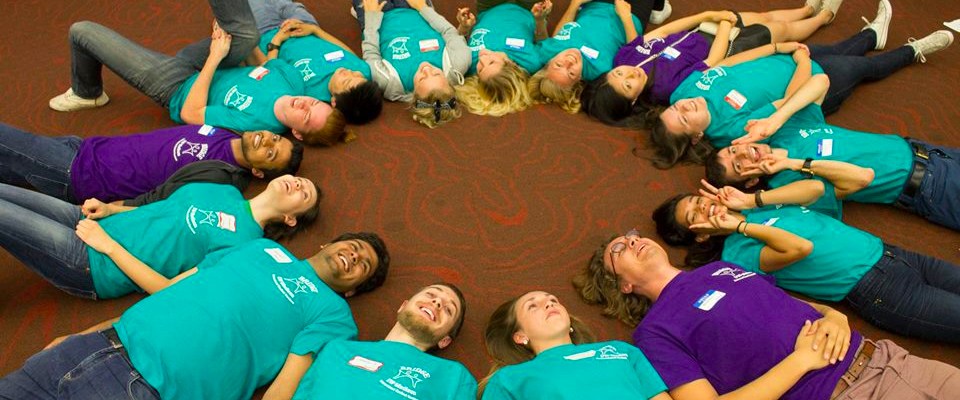

This article was written for J202, a journalism class at UW-Madison, and it is part of a bigger project, known as an Individual Story (IS). My IS topic was BRIDGE, an international friendship program at UW Madison, and this is my main text story for the project.
By Cara Hanson
“Let’s go red and white!” Students cheered from all sides of the student section as Simon Lebouvier looked down to the ice. It was his first hockey game. As an international student from Paris, Lebouvier was new to the chants. But by the end of the game, he could join in as a true Badger because of the help of a friend he met through BRIDGE.
Building Relationships In Diverse Global Environments, or BRIDGE, is UW-Madison’s international friendship program, designed to help international students immerse themselves in Wisconsin culture and encourage all members to become part of a culturally-diverse, international community on campus, according to the BRIDGE website.
The program works like this: each international student is paired with an American student using an online questionnaire and a group interview to match interests, according to BRIDGE coordinator Sabrine Ali. After they’re paired, members are expected to attend a few BRIDGE meetings each semester and to meet up with their partner outside BRIDGE events. This allows each partner to talk to their counterpart, learning about a new culture and immersing international students in the UW-Madison culture.
“We mix up all the different groups between American students and international students and they converse in smaller groups, based on different topics,” Ali said, describing a BRIDGE event known as the Intercultural Learning Workshop. “Whether that is education system in your country, popular culture’s dating culture, home life– and from these questions, students get to learn where there are some cultural similarities and differences.”
The number of incoming international freshmen has been increasing in the past few years, according to a story in the Wisconsin State Journal. Each year, UW-Madison hosts over 4,500 international students from over 100 countries worldwide, according to the International Student Services’ Guide for International Students. BRIDGE works to help these students from diverse cultural backgrounds find their place in Wisconsin culture.
It can be difficult for new international students to break away from the people they came with and meet new people, explained Ali.
“With BRIDGE, you get that extra push you need to be able to interact with a different group,” Ali said.
Lebouvier, a 22-year-old student majoring in engineering and business, decided to study abroad at UW-Madison because he wanted the American college experience. In his first few weeks on campus, however, he had a hard time becoming part of American culture.
“The very first weeks, I was spending way too much time with my French friends,” Lebouvier said. “I was speaking French way too often.”
He decided to join BRIDGE because he wanted to meet American people and make real friendships, more than simply attend classes with local students. Lebouvier was paired with his partner, Sarah, because of their common interest in volleyball, and he said they meet up three to four times each week. Each pairing is also part of a group of about 24 members, which, according to Ali, gives participants an outlet to meet people other than their partner.
“I also spend a lot of time with my BRIDGE group,” Lebouvier said. “They show us the nice places in Madison, like places to eat and dance.”
While BRIDGE provides a means for international students to fully experience Wisconsin culture, the benefit for American participants is less clear. The aim of the program, according to Ali, is for every member, American and international, to gain a meaningful experience from the program by asking questions and learning about the different cultures where participants come from.
Meghan Horvath, an American student at UW-Madison, participated in BRIDGE for two semesters, and while she feels the program is a great way for students to get exposure to the international community on campus, she thinks the program has a greater benefit for international participants than for Americans.
Horvath’s first semester BRIDGE partner was Rin, a South Korean student from Seoul. While she thought they had a good personal connection, Horvath explained that her partner gained more from the program than she did.
“I didn’t learn too much about her culture. She didn’t have other friends from Seoul in Madison,” Horvath said. “So it was more me introducing her to people I knew and other things that were Madison-related.”
Despite the potential gap in cultural exchange, Horvath, Ali, and Lebouvier agree that BRIDGE can be a powerful tool in creating global connections and friendships.
Ali, who has been active in BRIDGE since 2011, says that one of her favorite parts of the program is seeing lasting friendships develop between members across the world, even after their pairing is over.
This can be seen in Horvath’s relationship with Rin. Although their pairing ended three years ago, the students are still in touch.
“It’s nice to have that connection,” Horvath said. “Because we got pretty close and now we still talk. So if I ever end up in Seoul, you know, I’ve got a connection!”
Lebouvier was surprised by how easy BRIDGE made it to make friends with local and international students, and he said that nearly all of the friends he spends time with in Madison are BRIDGE connections.
“I thought it would be harder to make friends with American people,” Lebouvier said. “But thanks to BRIDGE, it wasn’t.”
For those with an interest in making friends from around the world, BRIDGE proves a tested option.
 carabynature.com